Verreries Schneider
1913 – 1938
Verreries Schneider stands as one of the most daring and iconic art glass manufactures of the Art Deco era. The glassworks established itself in the 1920s as the undisputed master of vibrant color and modern form, rivaling the premier glass houses of its time.
Biography
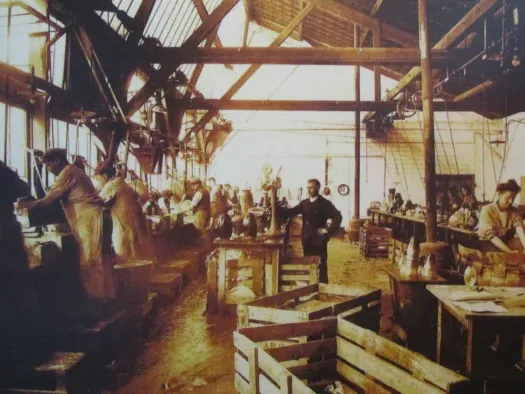
Trained in glassmaking at Daum in Nancy, Ernest (the administrator) and Charles (the artistic director) purchased a factory in Épinay-sur-Seine in 1913. Following World War I, they re-launched production, shifting exclusively toward high-end art glass.
The manufacture developed a spectacular palette of vivid, contrasting colors (tango orange, cadmium yellow, deep violet, cobalt blue). Multi-layered glass, internally colored and deeply acid-etched, became the aesthetic signature of pieces signed "Schneider”.
To reach a broader audience while preserving craftsmanship, they introduced the commercial line Le Verre Français (later incorporating the Charder trademark, a contraction of Charles Schneider). These stylized botanical and geometric vases, bowls, and lamps achieved overwhelming commercial success in France and the United States.
Awarded a Grand Prix at the 1925 International Exhibition of Decorative Arts in Paris, Verreries Schneider expanded to employ up to 500 workers. However, the Great Depression of the 1930s hit the glassworks hard, leading to bankruptcy in 1938 and marking the end of a golden age in Art Deco glassmaking.
"At Schneider, color bursts forth in bold harmonies; glass is no longer a simple vessel, but a sculpture of light etched with joyful geometry.”